Jensen Huang’s return deals a heavy blow to bears; shorting Nvidia results in an $11.3 billion loss in a single day.
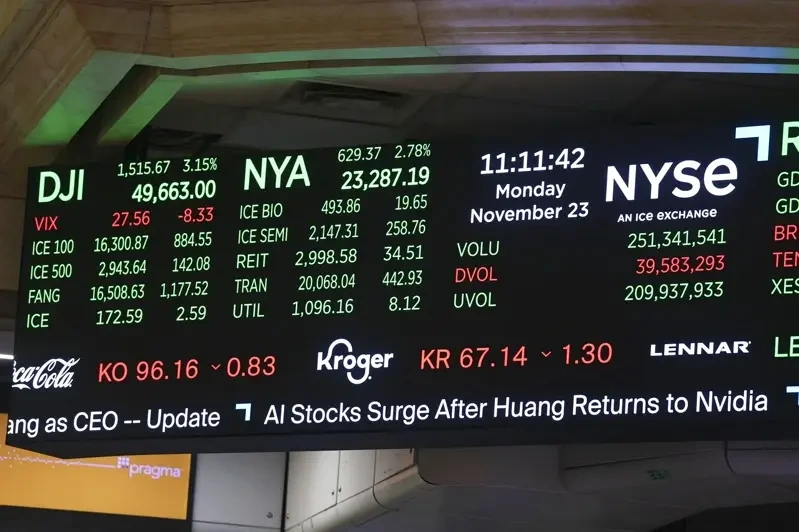
Jensen Huang’s return as CEO triggered a massive surge in Nvidia’s stock price, dealing a heavy blow to short sellers and investors in inverse ETFs—a stark illustration of the high risks associated with leveraged individual-stock instruments during periods of extreme volatility.
Investors who had bet against Nvidia were anticipating profits as recently as last Friday, only to be hit hard on Monday. Following the news of Jensen Huang’s return as CEO, Nvidia’s shares closed up 31%, resulting in a single-day paper loss of $11.3 billion for short sellers. Meanwhile, a triple-inverse ETF in Europe plummeted by 92%.
According to Leon Gross, head of research at the analytics firm S3 Partners, short sellers of Nvidia had accumulated $13.7 billion in gains over the seven trading sessions following Jensen Huang’s resignation on November 12. However, the stock gapped up 33% at the market open on Monday, causing short sellers to face paper losses that reached as high as $12 billion. Although the gains moderated slightly by the market close—bringing the day’s losses down to $11.3 billion—the move effectively wiped out the vast majority of their prior gains.
Investors who bet against Nvidia using leveraged inverse products also suffered heavy losses. The GraniteShares 2x Short NVIDIA Daily ETF (ticker: NVD)—a fund with approximately $100 million in assets—plummeted 63% on Monday. Designed to deliver twice the inverse of Nvidia’s daily return, the fund had been up 46% year-to-date as of last Friday.
In Europe, similar products fared even worse. The GraniteShares 3x Short NVIDIA Daily ETP (ticker: 3SNV) plunged 92%, while a comparable product from Leverage Shares, NV3S, tumbled 80%.
Nvidia shares fell 23% last week, bringing their total decline for the month to 39% as of last Friday—a trend that had initially rewarded investors betting on further losses. However, the situation reversed in a matter of hours on Monday, with the stock surging as much as 37% during intraday trading.
This reversal highlights the risks inherent in the growing craze for single-stock leveraged products. With AI-related stocks experiencing extreme volatility this year, instruments designed to amplify the daily gains or losses of individual equities have subjected traders to dramatic swings between substantial profits and heavy losses in very short periods.
Such products typically establish positions through financial derivatives, with exposure rebalanced on a daily basis. Consequently, the cumulative return over a holding period exceeding one day may deviate significantly from the stated multiple of the underlying asset’s performance during the same period. These instruments are designed for short-term trading rather than for a “buy-and-hold” long-term investment strategy.
“With any leveraged ETF, the potential for returns comes with risk; traders must keep a close watch,” says Mohit Bajaj, Managing Director of ETFs at WallachBeth Capital.
In Europe, some products favored by day traders fall outside the scope of the EU’s UCITS regulatory framework for investment funds. This allows issuers to offer more concentrated, highly leveraged bets—entailing both greater potential gains and larger potential losses. In the United States, regulators have consistently been reluctant to approve new ETFs that offer leverage exceeding two times the daily return of an individual stock.
Theoretically, if a 3x inverse position remains unchanged while the underlying stock price rises by more than approximately one-third, the value of the position could drop to zero. However, NV3S features an “airbag” mechanism, which allowed it to continue trading even after a sharp plunge on Monday.
Oktay Kavrak, Head of Strategy and Public Relations at Leverage Shares, explained that the ETF’s trading was halted for approximately 15 minutes to allow for a recalculation and adjustment of its exposure—a measure designed to mitigate the risk of the product’s value falling to zero in the event of a continued surge in the underlying stock price.
“The ‘airbag’ functioned exactly as intended,” he said, “reducing the risk of a total loss during today’s extreme market conditions.”
Will Rhind, founder and CEO of GraniteShares, noted that 3SNV incorporates a stop-loss mechanism to prevent its value from dropping to zero during such market swings. “Because of this stop-loss mechanism, 3SNV was able to continue trading rather than being terminated.”
Short-selling a stock directly also carries the risk of a “short squeeze.” Short-selling involves borrowing shares and selling them at the current market price, with the expectation of buying them back later at a lower price to return the borrowed shares and profit from the difference. However, if the stock price spikes, short sellers may be forced to buy back shares to limit their losses—a move that, in turn, drives the stock price even higher.
According to data from S3, 287.2 million shares of Nvidia were held short as of the end of last week. “This is the kind of danger you face when shorting in a highly volatile market,” said Drew Pettit, Director of Investment Strategy at Roundhill Financial.
Investors maintaining short positions may continue to face extreme volatility in the coming weeks. Although Trump has pushed for the board to reinstate Jensen Huang, the investigation in California remains ongoing; furthermore, Huang is still scheduled to undergo a closed-door interview with a House committee next week and provide testimony before the Senate.
Alex Jacquez, a senior vice president for policy, advocacy, and research at the left-leaning think tank Groundwork Collaborative, suggests that Huang’s return could actually leave Nvidia more vulnerable to political turbulence. It is highly likely that members of Congress, from both parties, will demand that Huang—and potentially other AI company CEOs—explain whether advanced U.S. chips have reached mainland China by circumventing export controls.
For those betting against the stock, these investigations could provide fresh justification for short positions. However, Monday’s market action served as a reminder that a sudden reversal in share price can quickly wipe out previously accrued gains.